
Choosing a conference venue is one of the biggest decisions in event planning, and one of the easiest to get wrong.
A venue that looks perfect in a brochure can reveal serious problems the moment you see it in person. The Wi-Fi cannot handle 300 delegates online at the same time. The room seats 400 in theatre style but only 180 at cabaret. The cancellation terms leave you financially exposed if attendance drops. The AV package that looked included in the hire fee turns out to require a preferred supplier charging three times the market rate.
Most planners shortlist venues quickly, based on photos and a headline price. The checks that actually prevent expensive problems happen too late, or not at all.
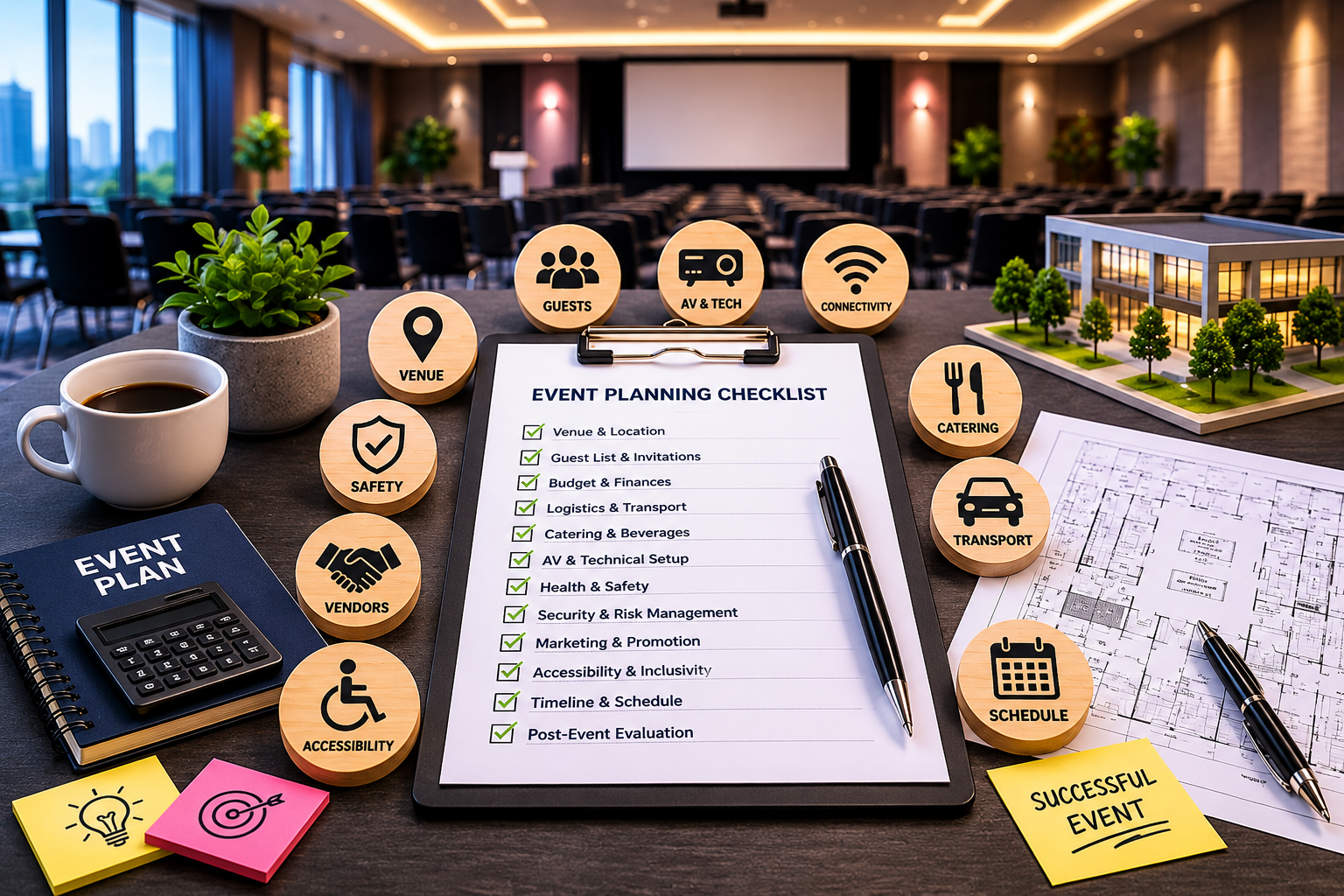
This conference venue checklist covers 12 things to confirm before you commit to anything. It is written specifically for professional association conferences, corporate events, and congress organising teams who need to get the venue decision right the first time.
If you want an experienced team to shortlist venues, carry out site visits, and handle the negotiation and contracting on your behalf, MICE Concierge provides a free venue finding service for professional associations and businesses. The cost is covered by the venue, not the organiser.
Before You Start: Define What Your Conference Actually Needs
Before you contact a single venue, you need clear answers to five questions. Without them, you will waste time visiting venues that cannot work for your event and comparing proposals that are not comparable.
| Question | Why it matters |
| How many delegates are you expecting, minimum and maximum? | Determines the room size you need and what the space must feel like if attendance is lower than projected |
| What seating layout do you need? | Theatre, cabaret, and round tables give very different capacities in the same room |
| What is your total budget, including all extras? | Many venues look affordable until preferred supplier fees, minimum spends, and overtime charges are added |
| Do you need breakout rooms or exhibition space? | Not all venues have flexible additional space beyond the main room |
| Is hybrid streaming required? | This sets the technical infrastructure requirements immediately and rules out many venues before you visit |
Every item on the checklist below filters venues against these five answers. Start with these and the shortlisting process becomes much faster.
1. Conference Venue Capacity
The most commonly misunderstood item on any conference venue checklist is conference venue capacity. Venue capacity is always quoted for a specific layout, almost always theatre style, which is rows of chairs facing a stage with no tables. It is almost never the number you will actually need.
The moment you add tables, you lose significant capacity. Here is a rough guide to what happens to the headline theatre figure in other layouts:
| Layout | Approximate capacity as a percentage of theatre |
| Theatre (rows of chairs, no tables) | 100% — this is the headline number |
| Classroom (chairs with tables, one side) | 50–60% |
| Cabaret (round tables, seats 70% full) | 50–60% |
| Banquet (full round tables) | 60–70% |
| Boardroom | Only suitable for small groups regardless of room size |
Never fill a room to its stated capacity. Aim for around 80% to allow for comfortable movement, additional AV and production equipment, registration tables near the entrance, and accessibility clearance around the room.
Before you shortlist, ask every venue for the capacity specifically in your intended layout, not the headline theatre number. Then ask what that conference venue capacity figure looks like if 20% fewer delegates attend than expected. A room that feels half-empty sends the wrong signal at a professional conference.
Also ask: does the room size include a stage, AV rig, or built-in registration desk area? If so, those elements reduce the usable delegate area from the quoted figure.
2. Conference Venue Location
Conference venue location affects attendance. A venue that is hard to reach will suppress delegate numbers before the event begins. This matters particularly for national association conferences where delegates are travelling from across the country.
Transport Links
The first check is rail. For most UK professional conferences, rail is the primary mode of travel for delegates. Is the venue within a reasonable walk, or a short, clearly signed taxi ride, from a mainline station? A venue that requires two changes and a bus from the nearest station will cost you delegate numbers.
Check road links too. What is the drive time from major motorway junctions? For international delegates or congresses, how far is the venue from an airport, and how long does the transfer take in normal traffic?
Parking
Ask exactly how many dedicated parking spaces are available on site. Is parking included in the hire fee or charged separately? Is there overflow parking nearby, and what is the realistic walking distance, including for delegates carrying equipment, with mobility needs, or arriving after dark?
Local Accommodation
If your conference runs over multiple days, delegates need somewhere to stay. Are there hotels within walking distance of the venue? Can those hotels offer a preferred delegate rate?
This is an area where expert support adds immediate value. MICE Concierge’s accommodation management service can handle the negotiation of delegate hotel blocks and preferred rates, working alongside your venue booking to give delegates a joined-up experience.
The Timing Test
This is one of the most overlooked checks in any venue shortlisting process. Visit the venue at the same time of day as your event will take place. A venue that is calm and easily accessible at 11am on a Tuesday can be gridlocked and difficult to park near at 8:30am on a conference morning in the same city.
3. Room Layout And Breakout Space: Does It Work For Your Programme?
Most conference programmes need more than one space. Plenary sessions, breakout workshops, networking areas, registration, catering, and exhibition space cannot all happen in the same room at the same time.
Before you visit, map out your programme and count how many separate spaces you need simultaneously at the busiest point of the day. Then ask the venue these questions:
- Can the main room be divided into smaller sections for breakout use, and how long does the changeover take?
- Are there dedicated breakout rooms available, and how many? Are they included in the hire fee or charged separately?
- Is there a dedicated registration area that is physically separate from the entrance to the main room?
- Is there exhibition or poster display space available? For association congresses with abstract presentations, this is often essential.
- Is there a speaker preparation room or green room?
- Is there a quiet space where delegates can step away from the main programme?
Once you have answers to these, walk the delegate journey. Start at the venue entrance and follow the route a delegate would take through registration, into the main room, out to a break, into a breakout session, to catering, and back. Look for pinch points, confusing navigation, and distances between spaces that will fragment the flow of the day.
The physical setup of a conference has a significant impact on how delegates experience the event beyond the content itself. The MICE Concierge blog post on designing a conference that delegates actually enjoy explores how room layout and delegate flow shape the overall experience, worth reading before you finalise your venue shortlist.
4. Wi-Fi And AV Equipment: The Questions Venues Hope You Do Not Ask
Wi-Fi and AV problems are the leading cause of disruption at professional conferences. They are almost always preventable with the right questions asked before booking. They are also the area where venues are most likely to tell you what you want to hear during a site visit.
Wi-Fi Questions To Ask Every Venue
Ask for the total bandwidth available, and specifically ask whether it is dedicated to your event or shared across the whole building with other guests, office tenants, or a simultaneous event.
Ask how many devices can connect simultaneously before the connection degrades. At a conference with 300 delegates who each bring a phone and a laptop, you need a network that can handle 600-plus devices at the same time.
Ask whether a dedicated hardwired connection is available for your AV production team and any hybrid streaming rig. A dedicated line ensures your most business-critical technology is not competing with delegates checking their emails.
Ask for the results of a recent independent speed test, not the claimed speed on the venue’s website. For a conference with 100 or more delegates, you need a minimum of 100Mbps symmetric bandwidth on a dedicated connection for a reliable experience across real-time polling, event apps, and streaming.
Av Questions To Ask
Ask exactly what AV equipment is included in the hire fee: projectors, screens, PA system, microphones, confidence monitors for speakers, and lectern. Then ask what is available at additional cost. Request a detailed av equipment inventory so nothing is missed.
Ask whether there is an in-house AV technician included in the hire, or whether that is a separate engagement.
Ask whether you are required to use the venue’s preferred AV supplier. This is one of the most common hidden costs in conference venue contracts and is covered in detail in item 5.
Ask whether the venue has hosted hybrid or live-streamed events before, and ask for a reference contact from a recent hybrid event specifically, not just a general testimonial.
Ask about the availability of a technical rehearsal slot for your production team and speakers before delegates arrive.
MICE Concierge’s AV integration service exists specifically for conferences that need a more controlled and reliable technical setup than a standard venue AV package can provide. If the venue’s AV provision is uncertain, bringing in a specialist team is the most reliable way to protect the quality of the day.
5. Hidden Costs And Preferred Supplier Clauses
The headline hire fee is rarely the total cost of a conference venue. This is the area where conference organising budgets most commonly overshoot, and the area that most venue checklist articles either skip or deal with in a single sentence.
Here are the most common hidden costs to identify before you commit.
Preferred Supplier Clauses
Many venues have commercial agreements with specific AV companies, caterers, or security firms. These arrangements mean the venue earns a margin when you use their preferred suppliers, and you may be required, or at least heavily pressured, to use them whether or not their pricing is competitive.
Before you sign anything, ask directly: “Are we required to use your preferred suppliers for AV, catering, or any other services? If we bring our own, what are your terms?”
If preferred suppliers are mandatory for certain services, ask for their full pricing in advance and compare it against open market rates before you factor it into your budget.
Minimum Spend Requirements
Some venues require a minimum food and beverage spend as a condition of hire. If your delegate attendance is lower than projected, or your catering needs are more modest than anticipated, you may still be liable for the full minimum spend.
Overtime And Access Charges
Your hire period may run from 9am to 5pm. But your AV team may need access from 7am for build-up, and your event may not finish clearing until 7pm. Extra access hours outside the contracted hire period are frequently charged at a premium rate. Clarify the exact hire period and access terms before you sign.
Corkage Fees
If your event includes a dinner or reception where you bring your own wine or spirits, many venues charge a per-bottle corkage fee. This can add meaningfully to your catering budget and is rarely mentioned upfront.
Service Charges On Catering
Catering invoices commonly include a service charge of 10 to 15 percent on top of the food and beverage cost. Confirm whether quoted catering prices are inclusive of service charge or whether it is added on top.
Cleaning And Damage Deposits
Some venues require a refundable damage deposit. Understand the terms under which it is retained before you sign.
The practical rule: always ask for a complete, itemised cost breakdown, including all likely extras, before you commit to any venue. Compare the total cost across your shortlist, not just the headline hire fee.
6. Conference Venue Catering: What To Confirm Before You Commit?
Conference venue catering is consistently one of the most-discussed aspects of any professional conference, both when it goes well and when it does not. Poor catering quality or a poorly managed service is one of the most common reasons delegates report a negative event experience.
Dietary Requirements And Allergens
Under the Food Information (Amendment) Regulations 2019, all food served at events in the UK must have allergen information clearly available. Confirm that the venue or its caterers have a documented process for managing allergens, not just a verbal assurance that they can handle it.
Ask whether the catering team can accommodate the full range of dietary requirements your delegates may have: vegan, vegetarian, gluten-free, halal, kosher, nut-free, and other common allergens. For association events with diverse memberships, this is non-negotiable.
Flexibility And Service Style
Ask whether the catering can be adapted to your programme, not just matched to a standard package. A buffet lunch that works operationally for 200 delegates is very different from a formal sit-down dinner. Confirm the service style suits your event flow.
Ask how many catering staff are included for your delegate numbers. A ratio of approximately one catering staff member per 25 to 30 delegates is a reasonable expectation for a seated lunch service.
Quality Assurance
Request a menu tasting before the event. Most professional venues will accommodate this for bookings over a certain value. If a venue declines without explanation, that is worth noting.
Ask for references specifically about the quality of the catering service on the day, not just the overall event. General venue testimonials rarely speak to food quality in any useful detail.
Exclusivity
Confirm whether you are required to use the venue’s in-house catering, or whether external caterers are permitted. If external catering is allowed, ask about kitchen access terms and any facility or corkage fees that apply.
7. Conference Venue Accessibility: Check The Full Delegate Journey
Under the Equality Act 2010, event organisers have a legal duty to ensure that their events are accessible to people with disabilities. The venue must support this, but accessibility planning is your responsibility, not the venue’s.
The most common mistake planners make is checking whether the conference room itself is accessible and stopping there. Accessibility needs to be checked across the entire delegate journey, from the moment a delegate arrives at the venue entrance to the moment they leave.
Walk this route during your site visit:
Car park or drop-off point to venue entrance: Is the route step-free? Is there accessible parking available near the entrance rather than at the far end of a car park? Is the surface even and well-lit?
Entrance to registration: Is there a step-free route? Is it clearly signed? Is there enough space at registration for a wheelchair user to wait and be served without obstruction?
Registration to the main conference room: Are there lifts as well as stairs? Check the lift dimensions, some older building lifts are too small to accommodate a powered wheelchair.
Main room to breakout spaces, catering areas, and toilets: Accessible routes must cover all delegate spaces, not just the primary conference room.
Accessible toilets: Confirm they are near the conference area, not just somewhere in the building. Check that they are large enough and fully operational during your site visit.
Beyond mobility, consider hearing loops or induction loop systems for delegates with hearing impairments, adequate lighting throughout for delegates with visual impairments, clear sightlines to the stage for wheelchair users positioned at the sides or back, and the availability of a quiet space for neurodivergent delegates who may need to step away from a busy room.
Do not rely on the venue’s assurances about accessibility. Walk the full accessible route yourself. Wherever possible, bring a colleague who uses a wheelchair or other mobility aid to give you an accurate picture of the experience.
8. Onsite Check-In And Registration: A Logistics Check Most Planners Miss
The registration area is the first physical experience every delegate has at your conference. A poorly designed or underpowered registration setup creates queues, frustration, and a negative first impression that colours everything that follows, regardless of how well the rest of the day goes.
This check is largely absent from most conference venue checklists. It deserves its own point.
At the venue, confirm:
Dedicated registration space: Is there a physically separate registration area, or does registration happen in the same corridor or foyer that delegates use to access the main room? The two should not compete for the same space.
Width and flow: How wide is the entrance corridor where registration will take place? Can multiple check-in desks operate side by side without creating a bottleneck? Is there room for a separate queue for pre-registered delegates and walk-ups?
Power availability: Is there sufficient power at the registration area for check-in kiosks, badge printers, and laptop stations? Ask specifically how many power outlets are available at the registration desk location, not in the main conference room.
Wi-Fi signal at registration: The Wi-Fi in the main conference room is not always the same signal strength at the registration area, particularly in older buildings or venues where the access points are positioned for the main room. Test the signal at registration specifically.
Storage nearby: Is there a secure area adjacent to registration for delegate bags, coats, and event materials?
Getting these basics right sets the tone for the whole event. The MICE Concierge guide to improving onsite check-in and badge collection covers the operational steps that make the registration process fast and professional, but those steps only work if the venue space supports them. Check this during your site visit, not on the day.
MICE Concierge’s onsite registration and badging service includes self-check-in kiosks, on-demand badge printing, and experienced staff. The right venue setup makes a significant difference to how smoothly this service operates.
9. Sustainable Conference Venue Credentials: What To Actually Ask For
Sustainability is now a procurement requirement for many professional associations, not just an aspiration. Delegates, sponsors, and member organisations increasingly expect visible evidence of genuine environmental commitment, not a paragraph on the venue’s website about recycling bins.
The challenge is that green claims are easy to make and hard to verify. Asking the right questions separates genuine commitment from marketing language.
Independent Certifications To Look For
ISO 20121 is the international standard for sustainable event management and covers the venue’s policies, processes, and performance across its events operation.
Green Tourism Gold, Silver, or Bronze certification is independently assessed and covers energy, water, waste, and biodiversity.
B Corp certification reflects broader social and environmental commitments across the whole organisation.
BREEAM ratings cover the environmental performance of the building itself, relevant for venues in newer or recently refurbished buildings.
Questions to ask the venue directly
- What percentage of food served is locally or sustainably sourced?
- What is your food waste management process, and do you work with a food redistribution partner?
- Do you use LED lighting throughout, and is energy use actively monitored and reported?
- What is your policy on single-use plastics?
- Is on-site recycling comprehensive and clearly accessible to delegates throughout the event?
- Can you provide data on your carbon footprint or energy use that we can include in our event’s sustainability reporting?
For association events with ESG commitments or sustainability-focused memberships, venue sustainability credentials are increasingly included in the formal RFP process. The MICE Concierge post on sustainable conference venues in London is a practical starting point for identifying venues that can genuinely support your sustainability objectives, and the broader MICE Concierge sustainability insights page covers how these principles apply across the full event planning process.
10. Hybrid Event Readiness: The Check That Cannot Wait Until Later
Hybrid capability is now a fundamental requirement for many professional conferences, not an optional extra. Yet most conference venue checklists still bury it inside a general technology point, which consistently underestimates what hybrid actually requires from a venue.
A venue that can host an in-person conference is not automatically capable of hosting a hybrid one. These are different technical environments with different infrastructure requirements.
What Hybrid Readiness Actually Means?
A dedicated fibre connection for the streaming rig, not shared building Wi-Fi, which is never reliable enough for a professional live stream under real event-day load.
Clear sightlines for cameras from multiple positions in the room. A stage set in a corner of a narrow room may work fine for in-person delegates but create impossible camera angles for a live stream.
Acoustic treatment in the room. A reverberant conference room can sound perfectly acceptable to the people inside it while sounding poor on the stream. Hard surfaces, high ceilings, and bare walls all increase reverberation, and it shows on video.
Confidence monitors or a screen visible to presenters that shows the virtual audience chat or live questions. Without this, speakers cannot engage with remote attendees in any meaningful way.
A dedicated technical control area for the streaming team, separate from the main room sightlines and away from delegate seating.
Adequate power for streaming encoders, cameras, and redundant connection hardware.
The Question That Matters Most?
Has this venue hosted a hybrid event of a similar scale before? Ask for a reference contact from a recent hybrid event specifically. When you speak to that reference, ask about the Wi-Fi performance and streaming stability on the day of the event, not at the technical rehearsal, and not based on the venue’s own assessment.
MICE Concierge provides full virtual and hybrid event delivery as part of its event management offer, including AV integration that can be coordinated directly with your venue’s infrastructure. If the venue’s hybrid capability is uncertain, working with a specialist team from the outset is the most reliable way to protect the quality of the live stream.
11. Venue Contract Terms: The Four Clauses That Matter Most
Venue contracts are long documents written in standardised legal language. Most planners sign them without reading them carefully, and most of the expensive surprises in conference venue bookings trace back to contract clauses that were not understood before signing.
These are the four clauses that cause the most problems.
1. Cancellation And Attrition Policy
The cancellation policy sets out what you owe the venue if you cancel at different stages. Most venues use a sliding scale, you lose your deposit for cancellation within 12 months of the event, and you owe 50 to 100 percent of the total contract value if you cancel within 30 to 90 days. Know the financial exposure at every stage before you sign, and model it against your event budget.
Attrition is the minimum number of delegates or room nights you are contractually committed to. If your attendance drops below this threshold, you may still owe the venue for the shortfall. Negotiate the attrition clause before signing, particularly if your attendance projections carry any uncertainty.
2. Force Majeure Clause
This clause defines what counts as an unforeseeable event that prevents the event from taking place and what the remedy is. Does the venue offer a full refund, a credit note, or only a rescheduled date? Does the definition cover the types of disruption that are realistically possible for your event, including extreme weather, travel disruption, or public health events? Read this clause carefully. Force majeure terms received significant additional scrutiny after 2020 and many standard venue contracts have not been updated to reflect a more realistic range of scenarios.
3. Preferred Supplier Restrictions
As covered in item 5, confirm in writing whether you are required to use the venue’s preferred suppliers for any service. If preferred suppliers are mandatory, their pricing should be obtained and included in your total cost assessment before you sign.
4. Exclusivity Arrangements
Is your event the only one taking place in the venue on your dates? If not, which spaces are dedicated to your event and which are shared? Noise from an adjacent event, competition for car parking, and a venue team with split attention between multiple bookings can all affect the quality of your conference. If exclusivity matters to your event, negotiate it into the contract explicitly.
The practical rule on all of the above: get every verbal agreement and every verbal commitment confirmed in writing before you sign. A venue coordinator’s assurance during a site visit carries no legal weight if it is not reflected in the contract.
12. The Site Visit
A photo on a venue website is a curated, often professionally lit moment from a sales presentation. A site visit is reality. It is the single most important step in this checklist and the one most often skipped when planners are working under time pressure.
Book your site visit at the same time of day as your event will take place. This is not a suggestion, it is essential. A venue that is calm and accessible at 2pm on a Tuesday will tell you almost nothing useful about what the experience will be at 8:30am on a conference morning.
What To Check That You Cannot See Online?
Sound and acoustics: Does sound travel between rooms? Will noise from a networking event in the foyer affect a breakout session next door? Does the main room have noticeable reverberation? A highly reverberant room causes delegate fatigue over a full conference day and makes it very difficult for speakers to be heard clearly without heavy PA support.
Natural light and temperature: Does the main conference room have natural daylight? All-day events in windowless rooms are a poor delegate experience regardless of the content quality. Is the air conditioning effective and controllable? A room that is too cold or too warm becomes a distraction within the first hour.
General condition: Is the venue clean and well-maintained? Does the condition of the furniture, flooring, and facilities match the standard your delegates will expect? Check the toilets specifically, both their condition and their number relative to your expected delegate count. This is one of the most common sources of delegate frustration at professional events.
Staff responsiveness: Pay close attention to how the venue team engages with your questions during the site visit. Are they knowledgeable? Do they answer directly or deflect? Do they follow up promptly after the visit? The way a venue sells to you is usually an accurate indicator of how they will perform when you are relying on them on the day of your event.
Bring a checklist and take notes during the visit. Take photographs of the registration area, room layouts, accessible routes, and anything that gives you pause. If your AV team is already confirmed, consider bringing them along, they will spot infrastructure issues that a non-technical planner will miss entirely.
A Checklist For Conference Venue Booking That Pays For Itself
Venue selection is not a task to rush through at the start of the planning process. The venue shapes the delegate experience from the moment they arrive to the moment they leave. It sets the practical parameters for your programme, your catering, your technology, and your budget. Getting it wrong is expensive, in money, in reputation, and in delegate satisfaction.
The 12 checks in this guide are the ones that separate a venue that works from one that looked right on paper. Most of them require a site visit and a conversation with the venue team. Some require a careful read of a contract. All of them are worth the time.
If you want an expert team to take the venue search off your desk entirely, shortlisting options, carrying out site visits on your behalf, negotiating terms, and managing the contract through to signature MICE Concierge’s venue finding service is free for event organisers. Their accommodation management service can be added to handle delegate hotel blocks alongside the venue booking. For full event delivery from registration through to onsite management, the event management and logistics service covers every element of the planning and execution process.
Frequently Asked Questions On Checklist For Conference Venue
How Far In Advance Should I Book A Conference Venue?
For large professional conferences and association congresses, booking 12 to 18 months in advance is standard. Popular city-centre venues and specialist conference centres fill quickly, particularly for autumn and spring dates. For events requiring hotel accommodation blocks for delegates, booking even further ahead gives you better rates and more choice. For very large international congresses, three to five years is not unusual.
What Is The Most Important Item On A Conference Venue Checklist?
The checks that matter most are the ones hardest to change after signing: capacity in your actual seating layout, AV and Wi-Fi infrastructure, and the cancellation and contract terms. These three areas cause the most expensive problems when they are not confirmed properly before booking. Everything else can be managed around, these three cannot.
What Hidden Costs Should I Watch Out For When Booking A Conference Venue?
The most common hidden costs are preferred supplier fees for AV and catering, minimum food and beverage spend commitments, access and overtime charges for build-up and breakdown time, corkage fees for external beverages, service charges added on top of catering invoices, and cleaning or damage deposits. Always ask for a full itemised cost breakdown before committing.
Do I Need A Venue Coordinator Or An Event Manager?
These are different roles. A venue coordinator manages the venue’s own team and internal services. They are not managing your event. For any conference with multiple sessions, external speakers, complex AV requirements, or a busy programme, you need a dedicated event manager or production team working exclusively for your event. If you do not have that resource in-house, a professional conference organiser can provide it. MICE Concierge offers full conference event management for professional associations including onsite management as part of a fully supported brief.
Can I Use A Venue Finding Agency To Help Me Shortlist?
Yes, and for most professional associations and larger corporate events this is strongly recommended. A specialist agency has existing venue relationships, knowledge of current rates and availability, and direct experience of which venues perform well for specific event types. MICE Concierge’s venue finding service is provided free of charge to event organisers, the cost is covered by the venue rather than the client.