The global virtual events market reached a staggering $44.28 billion in 2024, and analysts project it will surge to $231 billion by 2032. This monumental growth signals a fundamental shift in how organisations approach digital gatherings. Online events are no longer a temporary fallback or a secondary option. They now operate as a strategic centrepiece for associations, corporate enterprises, and professional bodies worldwide.
As we look toward 2026, the expectations placed on online event management in the UK and globally are shifting dramatically. Attendees now demand highly produced, engaging, and accessible digital experiences that rival television broadcasts. For event organisers and association leaders, keeping pace with these evolving standards requires a forward-thinking approach to technology, programming, and attendee support.
Understanding the upcoming shifts in virtual event management for associations is critical for maintaining strong attendance and delivering measurable value to sponsors. From sophisticated artificial intelligence tools to immersive audience participation strategies, the next generation of digital conferences requires a highly polished touch.
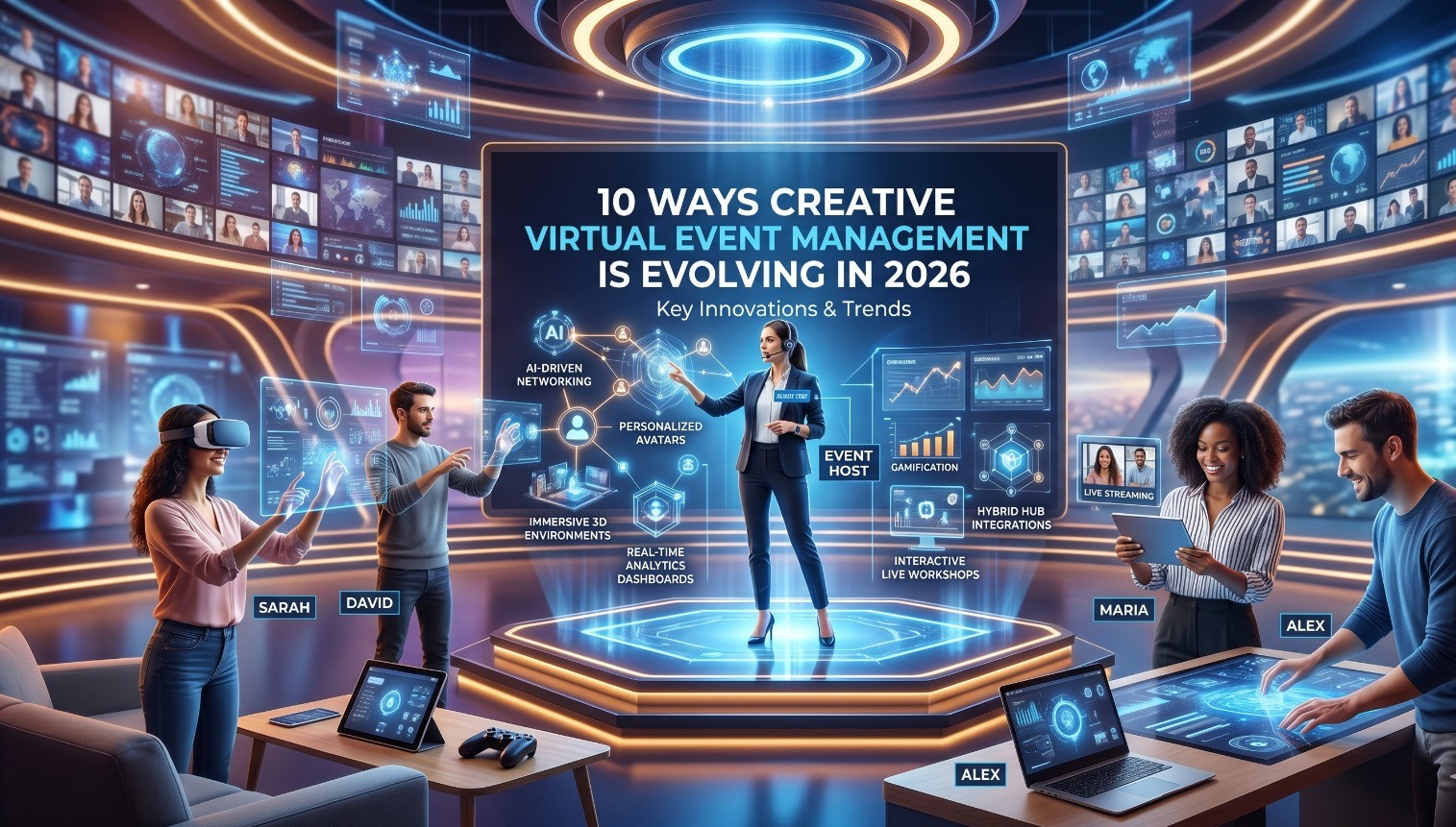
Here are the ten key trends shaping the future of creative virtual event management, along with practical insights to help your organisation stay ahead of the curve.
Trend 1: AI Co-Pilots Are Running The Event Lifecycle, Not Just The Email Campaigns
Artificial intelligence has officially moved past simple content generation. As we approach 2026, AI virtual event tools are executing complex, agentic tasks across the entire event lifecycle. Rather than just drafting marketing emails, these advanced systems are now capable of building dynamic session agendas, scoring sponsor leads based on real-time engagement data, and answering attendee technical queries instantly.
For association teams, this shift presents a massive opportunity to optimize internal resourcing. By delegating repetitive administrative tasks to AI co-pilots, your event management team can focus their energy on high-level strategy and relationship building. According to a report by Meetings & Incentive Travel magazine, AI tools are already being used to mine historic registration and engagement data to shape smarter programmes, and by 2026, this capability is expected to become standard practice. Furthermore, AI systems can automatically generate comprehensive post-event reports, synthesising thousands of data points into actionable insights within minutes of your closing keynote.
Trend 2: Hyper-Personalisation Replaces One-Size-Fits-All Programming
Modern delegates expect their digital conference experience to mirror the tailored algorithms of their favourite streaming platforms. Curated agendas, role-based session recommendations, and personalised networking suggestions are now the baseline expectation for creative virtual events. Presenting a static, one-size-fits-all schedule simply will not hold the attention of a diverse professional audience.
This high level of customisation relies heavily on first-party data. By securely capturing attendee preferences during the initial sign-up phase, event technology can map out a highly relevant journey for every individual. Integrating robust event apps allows organisers to deploy this personalisation technology seamlessly, ensuring delegates only see the sessions, exhibitors, and connections that provide them with immediate professional value.
Trend 3: Broadcast-Quality Production Raises The Bar For Virtual Attendance
Remote delegates no longer compare virtual conferences to standard internal video calls. They now judge them against professional television broadcasts. To capture and retain audience attention, broadcast-quality virtual events are becoming a strict requirement. The standard single-camera setup has been replaced by sophisticated multi-camera arrays, dynamic vision mixing, professional studio lighting, and highly trained presenters.
Delivering this level of polish requires significant technical expertise. Bringing a specialist partner on board to manage your virtual and hybrid delivery ensures you avoid the technical headaches that often accompany complex digital platforms. Through expert AV integration and robust backstage production, your digital broadcasts will project the same level of brand prestige and authority as your most successful in-person congresses.
Trend 4: Hybrid-First Design, Virtual Audiences Are No Longer An Afterthought
Industry data reveals that over 123 million hybrid events took place globally in 2025. This staggering figure highlights the rapid normalisation of dual-audience delivery. However, the benchmark for 2026 demands a highly intentional, hybrid-first design approach. The remote delegate experience must be planned from day one, rather than treated as a secondary stream tacked onto an established physical event.
As Event Industry News has reported, hybrid events are now among the top priorities for UK event planners — with the greatest challenge being delivering both audiences to the same high standard simultaneously. Successful hybrid delivery requires equal consideration for both audiences. If a physical attendee can ask a question, the digital attendee must have an equally frictionless way to participate. This means implementing integrated live polling, synchronised Q&A sessions, and dedicated virtual hosts who directly address the remote audience, ensuring they feel actively involved in the room’s energy.
Trend 5: Gamification Turns Passive Viewers Into Active Participants
Staring at a screen for hours naturally leads to fatigue. To combat this, creative virtual event management relies heavily on gamification. Interactive elements like live leaderboards, point-based challenge systems, reward-unlocking mechanisms, and competitive session polls effectively transform passive viewers into highly active participants.
Gamification is particularly effective for associations focused on community building. By rewarding delegates for visiting sponsor booths, contributing to chat discussions, or completing educational modules, you naturally encourage the exact behaviours that drive event success. Research from Tag Digital, a UK-based event marketing agency, highlights how AI-powered gamification, from gamified scavenger hunts to intelligent competitive challenges, is increasing dwell time, social sharing, and overall attendee retention at professional events. These virtual networking events create a sense of shared purpose and friendly competition, which significantly elevates the overall mood and energy of the digital conference.
Trend 6: Immersive Formats: AR, VR, And Virtual Environments Go Mainstream
Immersive virtual events are stepping out of the experimental phase and entering the mainstream. Thanks to rapid improvements in hardware and platform compatibility, augmented reality (AR), virtual reality (VR), and complex 3D environments are now highly accessible, even for organisations operating on mid-range budgets.
Attendees in 2026 can expect to navigate avatar-based breakout rooms, explore interactive virtual product showrooms, and engage with AR-enhanced technical presentations. These immersive formats provide a spatial dimension to online gatherings, helping to replicate the serendipitous interactions and physical exploration that make traditional in-person events so valuable. You can explore more about the long-term strategic value of immersive digital formats in our post on the long-term benefits of virtual events.
Trend 7: Shorter Sessions And Micro-Content Formats Drive Higher Completion Rates
The 90-minute virtual keynote is officially obsolete. Data shows that lengthy digital sessions suffer from severe audience drop-off. To maintain high virtual event engagement in 2026, planners are restructuring their agendas around micro-content. The new standard for an online presentation sits strictly between 20 and 30 minutes.
Associations must adapt to these shrinking digital attention spans. Breaking complex topics into digestible, bite-sized modules ensures delegates remain focused and retain the information presented. If a topic requires deep exploration, it is far more effective to schedule a series of short, punchy sessions separated by interactive breaks, rather than forcing attendees through a prolonged, exhausting broadcast. This approach also opens the door for repurposing content into on-demand libraries, a strategy we explore further in Trend 10.
Trend 8: Data-Led Event Management Replaces Instinct-Based Planning
Sponsors and executive boards demand hard evidence of return on investment. Instinct-based planning has been entirely replaced by data-led event management. Modern platforms provide organisers with incredible visibility into attendee behaviour, tracking session dwell times, virtual booth interactions, and real-time engagement scoring.
Mastering virtual event ROI measurement requires robust technical infrastructure. Our EventsAir partnership provides clients with access to market-leading analytics, allowing you to maintain full control and visibility over your event’s performance. According to Event Industry News, 45% of UK event organisers are already actively using AI tools to enhance operations and personalise attendee experiences, a figure that is accelerating rapidly.
Trend 9: Accessibility And Inclusion Become Non-Negotiable Baseline Requirements
With the European Accessibility Act (EAA) having come into force in June 2025, the regulatory landscape for digital platforms has tightened significantly. For event organisers, this means virtual event accessibility in the UK and Europe is now a strict legal and ethical requirement.
As digital accessibility specialists AbilityNet explain, the EAA applies to any organisation providing products and services to consumers in the EU, including UK businesses, and mandates accessible digital experiences for people with disabilities. Creative virtual events must therefore feature multilingual live captioning, seamless screen reader compatibility, BSL interpretation options, and highly responsive mobile designs. Building these inclusive frameworks into your digital platform from the outset ensures every professional can access your content without facing unnecessary barriers and keeps your organisation fully compliant with UK and EU obligations.
Trend 10: Virtual Events As Year-Round Community Engines, Not One-Off Broadcasts
The most successful associations view their virtual event infrastructure as a continuous, 365-day engagement tool. Rather than treating an online conference as an isolated, annual broadcast, they leverage the platform to sustain their community year-round.
By repurposing session recordings into rich, on-demand learning libraries and keeping virtual networking channels open, organisers create sustainable virtual events that deliver continuous value to members. The conference production decisions made during planning, from session length to format diversity, directly influence how much usable content you are left with once the event closes. Associations that plan for this from the start come away with a 12-month content and engagement asset, rather than a single day’s broadcast.
The Future Of Creative Virtual Event Management Starts Here!
The virtual event trends for 2026 point clearly toward higher production values, deeper personalisation, and frictionless accessibility. For associations and corporate planners, keeping up with these rapid technological advancements can feel daunting. However, you do not have to integrate every new technology simultaneously. The most effective approach is to prioritise the trends that directly support your organisation’s primary goals, whether that is improving sponsor ROI through data, or boosting delegate retention through shorter, gamified sessions.
With many moving parts to coordinate, an event’s success hinges on the seamless management of every component. Partnering with a trusted specialist in creative virtual event management allows you to implement these sophisticated strategies without overburdening your internal team. From comprehensive conference event management to meticulous event management logistics, bringing in expert support ensures your virtual and hybrid events operate flawlessly.
We have an industry-leading setup designed to handle the complexities of modern digital gatherings. Whether you need us to build a seamless pre-event registration portal or take full ownership of your attendee management, we can lend a hand to whatever extent you require. Our most popular option sees us take the stress off your hands entirely, operating as a dedicated extension of your own staff.
If you are ready to elevate your virtual event strategy for 2026 and deliver a truly broadcast-quality experience for your delegates, contact us today to discuss how we can bring your next creative virtual event to life.
Frequently asked Questions
What Is Creative Virtual Event Management?
Creative virtual event management is the strategic planning, technology selection, content design, and live production of online and hybrid events with a deliberate focus on attendee engagement, personalisation, and broadcast-quality delivery. It goes beyond simply hosting a video call, it involves orchestrating a fully managed digital experience that delivers measurable value to delegates, sponsors, and association leadership alike.
What Are The Biggest Virtual Event Trends For 2026?
The key trends are AI-powered personalisation, broadcast-quality production, hybrid-first design, gamification, immersive AR/VR formats, shorter micro-content sessions (20–30 minutes), data-led event management, and using virtual infrastructure as a year-round community engine rather than a one-off broadcast.
How Do You Keep Virtual Event Attendees Engaged?
Keep sessions short (20–30 minutes), personalise agendas to each delegate’s role and interests, and build in live polls, Q&A, and gamification throughout. Broadcast-quality production is equally critical, a polished, well-directed stream commands attention in a way that a static webcam feed simply cannot.
What Is The Difference Between A Virtual Event And A Hybrid Event?
A virtual event is fully online, with all attendees joining remotely. A hybrid event runs simultaneously for both an in-person audience and a remote audience. In 2026, best practice requires hybrid-first design, where both audiences receive equal consideration from the very first planning meeting, not as an afterthought.
How Much Does Virtual Event Management Cost For Associations?
Costs vary significantly based on scale and production requirements. A straightforward webinar-style event typically starts from around £2,000, while a full broadcast-quality virtual conference can start from £15,000 or more. Key cost drivers include production quality, platform choice, attendee numbers, and the level of managed service required. Contact us for a tailored quote.
Can Virtual Events Replace In-Person Conferences For Associations?
Virtual and hybrid events complement rather than replace in-person gatherings. They extend your reach to global audiences, reduce barriers to participation, and enable year-round member engagement between annual conferences. However, in-person events remain the gold standard for deep networking, relationship building, and the kind of spontaneous professional connections that digital formats still struggle to replicate.