There’s a moment every event planner quietly dreads. You’ve budgeted £8 a head for branded merchandise, ordered 600 units, arranged distribution at the check-in desk and by 4pm you spot a lanyard-strangled stress ball rolling under a catering table, abandoned. The bin is already doing the networking.
Event giveaways have a retention problem, and it costs the industry millions each year. Research consistently shows that 40% of corporate gifts are thrown away immediately after being received, with just 16% kept long-term. For event professionals who spend considerable time and budget on branded merchandise, that’s a sobering stat.
But here’s the thing: the problem is never giveaways themselves. The problem is the wrong giveaways, distributed to the wrong people, at the wrong moment. Get those three variables right, and the picture changes dramatically.
What Makes an Event Giveaway Worth Keeping?
Before diving into product categories and distribution tactics, it’s worth establishing the underlying logic, because most giveaway decisions are made backwards, starting with “what’s available at this price point” rather than “what would this specific person actually use.” The items that earn a place in someone’s daily routine share a recognisable set of properties, and understanding those properties is what separates a brand impression that lasts eight months from one that lasts eight minutes.
The most-kept event giveaways share three properties, genuine daily utility, quality that signals intent rather than obligation, and sustainable design. Items that solve a real problem the attendee faces, at the event or in their working life, consistently outperform novelty items by a significant margin.
BlinkSwag’s 2025 analysis, drawing on RainFocus data and post-event surveys, found that 85% of participants keep at least one item for eight months or longer when it ticks three boxes: daily utility, quality feel, and sustainable design. Eight months of daily use, for a branded item that costs you £12. That’s a cost-per-impression no digital banner is going to match.
The framework is straightforward, even if the execution takes discipline:
- Utility value: Does it replace or improve something the attendee already uses daily?
- Portability: Will it survive the journey home, or does it require its own luggage?
- Quality signal: Does it say “we chose this for you” or “we ordered the minimum”?
- Brand placement: Is the logo a clean accent, or does it scream like a toddler in a library?
- Sustainability: Is the material something the recipient can feel good about keeping?
If your giveaway fails on more than one of these, you’re not building brand recall. You’re funding landfill.
The Sustainability Shift: Why Eco-Friendly Giveaways Now Drive ROI
Sustainability has moved from a conference theme to a purchasing criterion — and nowhere is that shift more visible than in what attendees actually take home. The merchandise decisions planners make in 2026 aren’t just a reflection of budget; they’re a reflection of organisational values. And delegates are reading that signal more carefully than ever.
Attendee Values Have Moved: Has Your Merchandise?
Sustainability is no longer a nice-to-have framing device for your event website. It’s become a direct driver of whether attendees actually use what you give them. In 2026, 31% of Gen Z say sustainability is important when receiving a promotional product, compared to just 6% of Boomers, a gap that reflects the shifting age profile of conference and congress attendees across professional industries. If your event skews towards younger delegates (and most industry conferences now do), that’s nearly one in three attendees evaluating your giveaway through a sustainability lens before they’ve even decided whether to pack it.
Over 72% of consumers prefer promotional items that are eco-friendly or made from sustainable materials, and 73% of millennials say they’d pay more for sustainable products, a signal about perceived value that translates directly to retention rates. For planners thinking holistically about their environmental footprint, MICE Concierge’s guide to sustainable conference venues in London is a useful companion read when aligning venue choice with merchandise strategy.
Eco-friendly event giveaways outperform cheap plastic alternatives on every retention metric. Items made from recycled materials, bamboo, or organic cotton are used longer, generate more brand impressions, and communicate organisational values more effectively than disposable alternatives.
What The ROI Data Actually Says
The business case for sustainable merchandise is no longer an ethical argument, it’s a financial one. According to an ASI study, every £1 spent on promotional products generates £6.41 in brand impact, and sustainable products outperform that average. That’s before accounting for the reputational cost of being photographed next to a bin full of your branded stress balls.
A 2026 study by PPAI and ASI found that branded merchandise generates up to 8x less carbon per impression than digital advertising, which gives sustainability-focused event planners a double argument: better for the planet and better for the budget. The data, in short, has caught up with the intuition that quality sustainable merchandise is worth the investment.
The Best Event Giveaways by Category (Ranked by Retention)
Not all merchandise is created equal, and the difference between a 15% retention rate and an 85% retention rate isn’t price, it’s category. Some product types have structural advantages: they’re used daily, they travel well, they address needs that arise at the event itself. Others rely entirely on novelty, which fades approximately as fast as the lanyard tan. What follows is an honest category-by-category assessment, ranked by the metric that actually matters: how long it stays out of the bin.
Tech Accessories: The Consistent High Performers
Tech accessories lead the retention table for a straightforward reason: they’re useful at exactly the moment they’re received. A delegate whose phone battery hits 12% during the afternoon sessions will feel a disproportionate amount of goodwill towards whoever gave them a power bank that morning.
Tech accessories are the highest-retention category in event merchandise. Power banks, USB hubs, and charging cables address a need that arises at the event itself, creating immediate utility and a positive brand association before the delegate has even left the building.
59% of event attendees say tech accessories are their favourite giveaways, and the retention data reflects that preference in practice. Tech accessories lead all categories with an 85% retention rate, power banks and USB hubs specifically, with items generating over 5,700 brand impressions in eight months at a cost-per-impression under £0.003. For multi-day conferences and congresses where delegate fatigue and device dependency are both real factors, tech accessories serve a functional purpose that makes their distribution feel like a service rather than a sales pitch.
Top-performing tech giveaways:
- Portable power banks (slim profile, 10,000mAh minimum)
- Multi-port USB hubs
- Branded wireless earbuds
- Cable organisers and travel charging kits
- Screen-cleaning sets, underrated, used daily, visible constantly
Drinkware: The Workhorse Category
Branded drinkware has been the workhorse of event merchandise for decades, and the data suggests it’s earned that status. What separates the drinkware that enters someone’s daily rotation from the drinkware that joins the accumulation under the office sink comes down to a single variable: quality. A quality insulated bottle or travel cup integrates into daily routines in a way that a cheap alternative rarely manages, because the act of using it reinforces the brand association rather than undermining it.
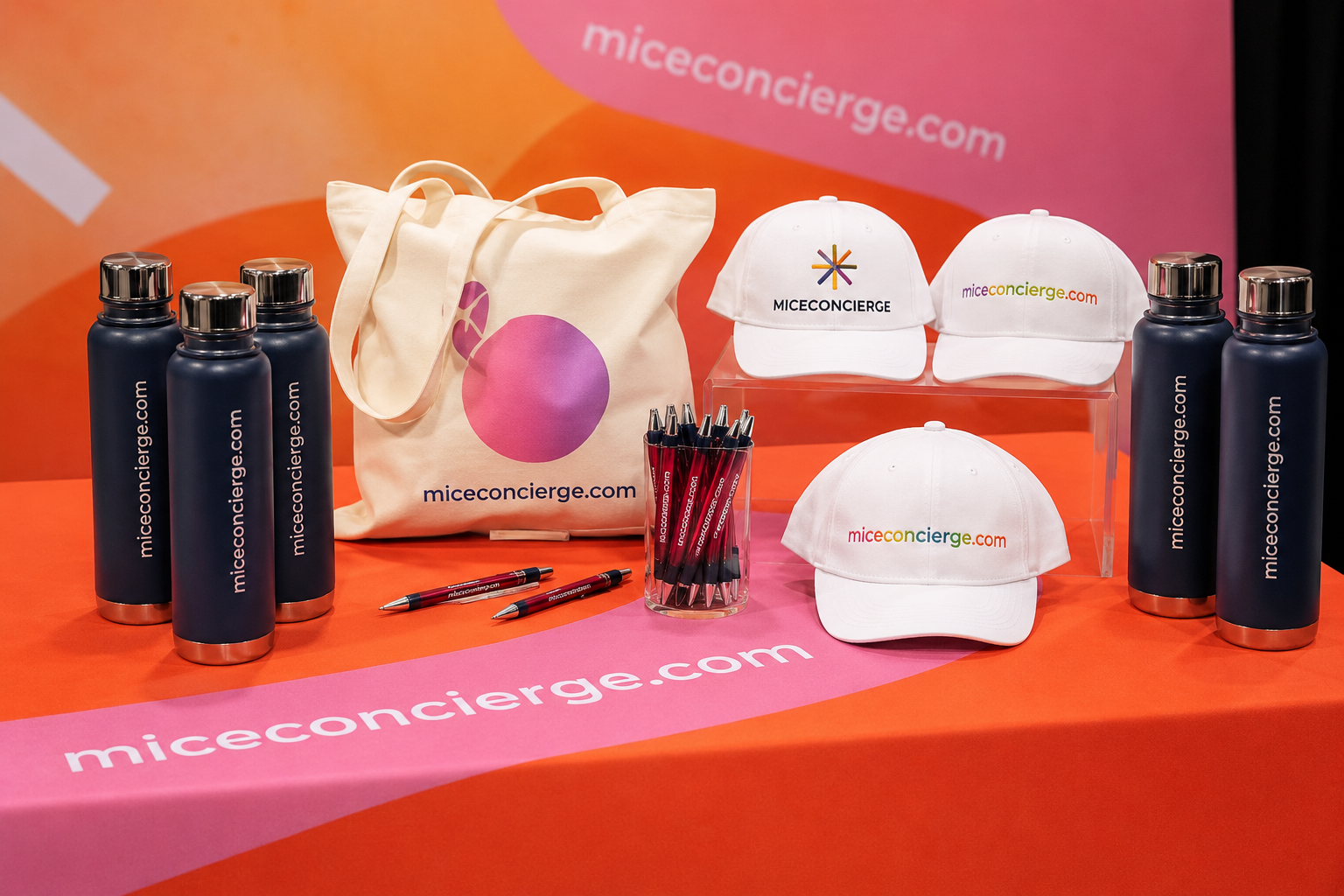
Drinkware achieves a 63% retention rate across categories, second only to tech accessories, and for events with a sustainability focus it carries an additional signal value. Handing delegates a reusable bottle is also implicitly saying something about your event’s values, which is increasingly relevant to how attendees write up their experience on LinkedIn afterwards. The key word, as always, is quality. A thin-walled bottle that doesn’t keep coffee hot signals the same thing as a cheap pen: that the organiser prioritised unit cost over the delegate’s actual experience.
Apparel: High Aspiration, Uneven Execution
Apparel occupies a peculiar position in event merchandise: it’s the most-wanted category and one of the least consistently delivered. The gap between what attendees want to receive and what they actually wear is where most branded apparel budgets go quietly missing.
T-shirts are consistently the number one most-wanted promotional product, and hoodies rank second at 40% of respondents, yet only 13% say they actually use a branded hoodie most often. That gap between wanted and used is almost always an aesthetic and fit problem. Branded apparel that looks like a uniform gets worn once, if at all. Apparel that looks like something the delegate would actually choose, clean colourways, quality fabric, minimal logo placement, enters rotation.
Premium fabrics from recognisable manufacturers signal a deliberate gift, not a bulk order, and that perception elevates the brand logo it carries. Neutral colourways consistently outperform heavily branded colours in wear frequency, because recipients reach for what fits their wardrobe. The practical implication: budget up, or skip apparel entirely. A mediocre hoodie is worse than no hoodie.
Notebooks And Stationery: Still Relevant, Rarely Memorable
Quality notebooks maintain a steady retention rate among professional audiences and have the advantage of being used at the event itself, which creates an immediate and visible utility. Delegates seen using a branded notebook throughout a conference day are also functioning as passive brand ambassadors, a bonus that most other giveaway categories can’t claim. The challenge is that this category is saturated. Every second event produces a branded notebook, which means yours needs to earn its place on the desk through genuine quality rather than sheer familiarity.
If you’re going to invest in stationery, invest properly, a lay-flat binding, heavyweight paper, a dot-grid format rather than the default line, and a pen loop that includes a quality pen most delegates wouldn’t have bought themselves. A well-chosen pairing elevates both items. An afterthought notebook with a budget biro confirms every suspicion the attendee already had about your merchandise budget.
What the Bin Is Actually Telling You: Common Giveaway Mistakes
If event giveaways keep ending up discarded, the bin isn’t the problem, it’s the feedback mechanism. Understanding why items get thrown away is more useful than ordering different items next year and hoping the outcome changes. Most giveaway failures trace back to one of three consistent mistakes, and all three are avoidable with a combination of better data and clearer thinking about what the giveaway is actually for.
Mistake 1: Ordering Quantity Rather Than Quality
The maths feels reassuring in a budget spreadsheet: 500 units at £3 each versus 200 units at £8 each. But items with no real value to the consumer are more likely to be thrown away quickly, which means the cheaper option frequently generates zero brand impressions post-event. The more expensive option, used daily for eight months, generates thousands. Cost-per-impression rates for high-retention items such as power banks can fall as low as £0.002, compared to £0.05 or more for disposable promotional items, a ratio that makes the quality argument in financial terms rather than aesthetic ones.
Mistake 2: Ignoring Distribution Strategy
Where and how you distribute giveaways significantly affects their perceived value, and this is where most events leave the most on the table. Items handed out in bulk from a table at registration carry less weight than items that feel curated, staged, or earned. The check-in desk is often where giveaway distribution is planned and often where it goes wrong, because handing everything out in one go at registration, alongside a badge and a lanyard and a tote bag, creates sensory overload and reduces the perceived value of every individual item.
For events using badge collection as part of a curated welcome experience, distributing giveaways at that touchpoint with a brief moment of human interaction rather than a bulk drop, meaningfully increases the perceived care behind the gift. Consider tiered distribution, where different items go to different audience segments, or staged distribution, where items are given at the moment they’re most relevant rather than all at once.
Mistake 3: Missing The Audience
88% of attendees feel more connected to a brand when a product is personalised, and 68% are more likely to view a brand positively when it offers premium-quality products. Personalisation doesn’t necessarily mean printing every delegate’s name on a pen. It means understanding what the specific audience values and choosing accordingly. A medical congress audience and a tech startup founder summit have completely different retention profiles. This is where your delegate registration data becomes genuinely useful, segmenting your audience before the event lets you make smarter, audience-specific merchandise decisions rather than defaulting to the universal notebook.
Giveaway Comparison Table: What Gets Kept vs. What Gets Binned
Understanding retention rates in the abstract is useful; seeing them side by side makes the decision clearer. The table below draws on category-level data from ASI, BlinkSwag, and VistaPrint research to give planners a practical reference point when comparing options against budget and event type. The risk column is not a reason to avoid a category — it’s a reason to go in with your eyes open.
| Category | Avg. Retention Rate | Best For | Risk |
| Power banks / Tech accessories | 85% | Multi-day conferences, tech events | Higher unit cost |
| Insulated drinkware | 63% | All event types | Only if genuinely quality |
| Quality apparel (premium fabric) | 62% | VIP / speaker gifts, smaller events | Sizing and aesthetic execution |
| Branded notebooks (premium) | ~50% | Professional / academic conferences | Saturated category |
| Tote bags (canvas, quality) | ~45% | Trade shows, consumer events | Logo placement critical |
| Eco items (seed paper, bamboo) | Variable | Sustainability-focused events | Novelty without utility |
| Plastic pens / stress balls | <15% | Nothing justified | The bin |
Giveaways as Part of the Wider Attendee Experience
The most effective event giveaways don’t exist in isolation, they’re one touchpoint in a designed attendee journey that begins long before anyone sets foot in the venue. When giveaway strategy is integrated with the broader event experience, from online registration through to conference design and post-event engagement, the individual items carry more weight because they feel like part of something considered rather than an afterthought bolted onto the logistics.
Event giveaways increase booth traffic by 60%, and more than half of attendees remember a brand better after receiving a promotional product but those numbers assume the item is worth remembering. An item that gets discarded at the venue achieves neither outcome, and the giveaway budget becomes a rounding error rather than a brand investment. For events that include post-event engagement in their planning, the giveaway itself can serve as a physical trigger, a useful item used daily that prompts the attendee to recall the event, the session, the conversation that mattered. That’s not an accidental recall. It’s a design recall.
Sustainable Giveaways: Practical Options for 2026
If your event has any sustainability commitments and with regulatory pressure on the events industry increasing year on year, more events do the merchandise table is a highly visible place to either demonstrate or undermine those commitments. Sustainable giveaways in 2026 range from straightforward material substitutions (recycled PET instead of virgin plastic) to genuinely novel approaches that reframe what a giveaway can be. The following options are practical, available at scale, and backed by retention data that justifies the investment.
Practical sustainable giveaway options that perform well:
- Recycled PET power banks, functional, tech-forward, clear sustainability signal
- Bamboo drinkware increasingly quality at scale, strong visual identity
- Seed paper notebooks, plantable after use, strong sustainability narrative, best paired with a quality pen
- Organic cotton tote bags, only if genuinely useful and well-designed; the events industry does not need more tote bags
- Digital giveaways, premium app subscriptions, curated resource libraries, or exclusive content access delivered via QR code at check-in
The digital giveaway option is underused and worth flagging specifically. For professional events where attendees are time-poor and already carrying too much, a curated digital resource can outperform physical merchandise on both perceived value and environmental footprint. Zero waste, high perceived utility, and infinitely scalable, it’s the one category that gets better the more attendees you have rather than worse.
Event Giveaways That Work Aren’t an Accident
Event giveaways don’t have a relevance problem. They have an execution problem. The data is consistent: the right item, given at the right moment, to the right person, with the right quality signal, generates brand recall that outlasts the event by months. 83% of people remember the advertiser on a promotional product, and over half keep it for 12 months or more but only when the item earns its place in someone’s daily routine.
Earning that place requires thinking about event giveaways not as a line item in the venue contract, but as a designed touchpoint in the attendee experience. It requires registration data that tells you who’s coming and what they value. It requires a check-in experience smooth enough that the giveaway moment doesn’t get swallowed by a queue. It requires someone at some point in the planning process to have held the proposed item and asked: would I actually use this?
If the honest answer is no, the bin already knows.
MICE Concierge provides end-to-end event management services including onsite check-in, delegate registration, and badging solutions for conferences and congresses. Find out how we support event planners from registration to the room.
Frequently Asked Questions About Event Giveaways
What Are Event Giveaways?
Event giveaways are branded items distributed to attendees at conferences, trade shows, or corporate events. They serve as a tangible brand touchpoint, designed to extend recall beyond the event itself. The best ones earn a place in daily routines; the worst ones earn a place in the nearest bin.
What Are Good Giveaways For Events?
The best event giveaways combine daily utility, quality finish, and sustainable materials. Tech accessories (power banks, USB hubs), insulated drinkware, and premium apparel consistently achieve the highest retention rates with power banks holding an 85% keep rate at eight months or more. If an attendee wouldn’t miss it when it’s gone, it wasn’t good enough.
What Are Conference Giveaways Called?
Conference giveaways are commonly called swag, branded merchandise, or promotional products. In the events industry, “swag” typically refers to the full collection of items given to delegates, often distributed at registration or the check-in desk. The term originates from “Stuff We All Get,” though quality swag has made that collective groan increasingly undeserved.
What Is Swag For Events?
Event swag is any branded item given to attendees as part of the event experience from tote bags and notebooks to tech accessories and apparel. In 2026, the best event swag is sustainable, useful, and deliberately chosen for the specific audience rather than ordered in bulk at the lowest unit cost.
What Are The Top 3 Most Popular Gift Categories?
The three most popular event gift categories by retention and attendee preference are: tech accessories (power banks, charging cables, USB hubs), drinkware (insulated bottles and travel cups), and apparel (T-shirts and hoodies, when quality and fit are right). Tech leads with an 85% retention rate, drinkware follows at 63%, and quality apparel at 62%.